Water Damage Restoration in Davie
Water damage restoration in Davie and surrounding areas. Insurance billing accepted. Call (954) 932-5420.
What happens in the first 48 hours matters more than anything else
You notice the carpet squishing underfoot, or spot a brown stain spreading across the ceiling drywall, or walk into the laundry room and hear the faint sound of water moving somewhere it shouldn’t be. Within 24 to 48 hours of a water intrusion, mold spores already present in any home can begin colonizing wet building materials. The clock on a water damage event starts the moment moisture contacts your structure, not when a crew arrives. What RestorationXpress does in those first hours determines whether you’re dealing with a drying job or a gut-and-rebuild.
What Water Damage Restoration actually involves
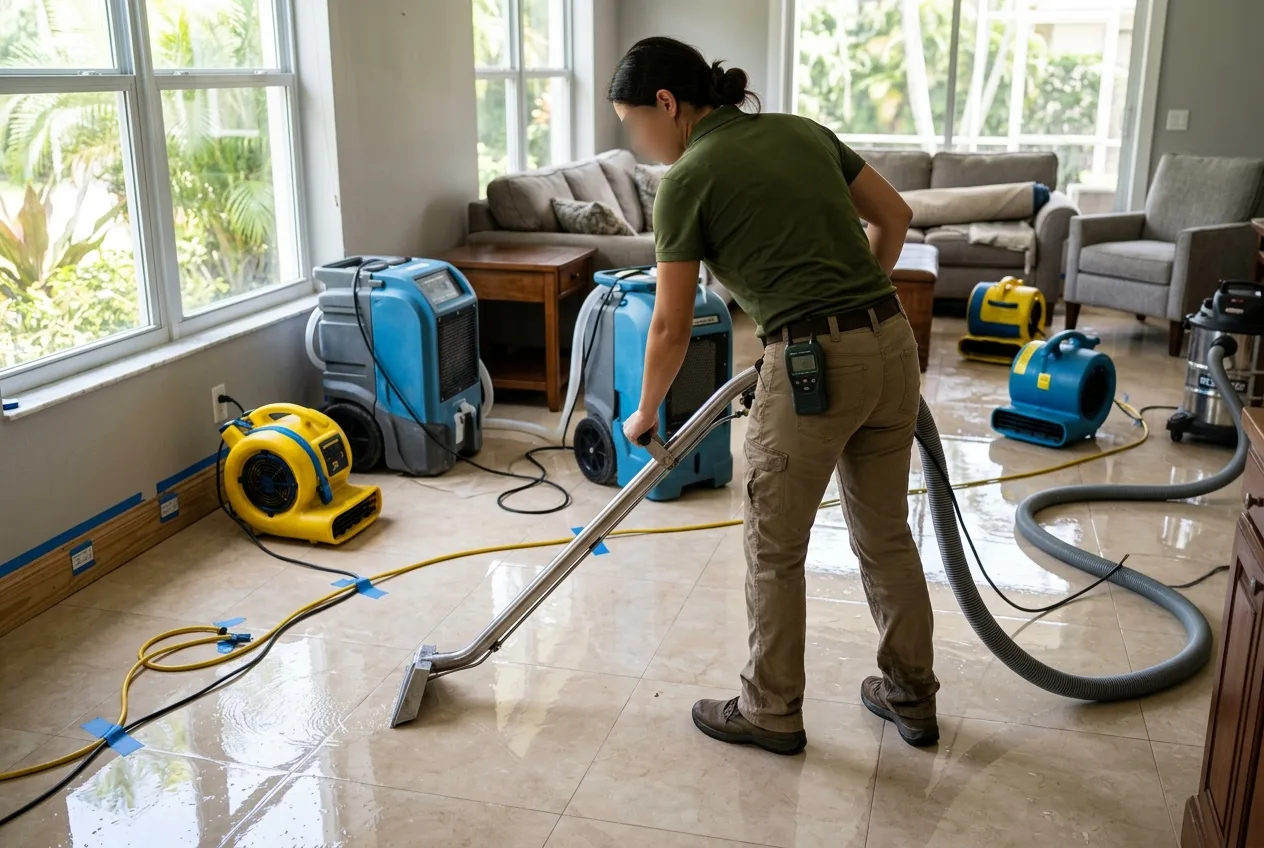
Water damage restoration is not mopping up and running a fan. It is a sequenced technical process that tracks moisture through materials you cannot see, inside wall cavities, beneath subfloor sheathing, behind baseboards, inside insulation bays. The work uses truck-mounted or portable extraction units capable of removing hundreds of gallons of standing water, followed by industrial low-grain refrigerant (LGR) dehumidifiers and high-velocity air movers positioned to create a controlled drying chamber around affected assemblies.
Moisture readings are taken with penetrating and non-penetrating meters at every affected surface and logged against manufacturer dry standards, the target is not “dry to the touch” but documented psychrometric data showing materials have returned to acceptable moisture content. On a typical Category 1 clean-water loss (burst supply line, appliance overflow), structural drying runs three to five days. Category 2 losses involving gray water, dishwasher backflow, washing machine discharge, toilet overflow without solid waste, require additional antimicrobial treatment and more aggressive material evaluation. Category 3 losses (sewage, floodwater, any water that has sat long enough to become grossly contaminated) involve containment protocols, PPE, and in most cases removal of porous materials that cannot be adequately cleaned.
Timeline, equipment count, and material decisions all depend on the water category and how long saturation has been occurring, two variables that change the scope of work significantly.
Our process
-
Rapid assessment and water source control. Before extraction begins, the source of intrusion is identified and stopped or isolated. Extracting water while a pipe is still leaking wastes time and worsens the loss. Moisture mapping at this stage documents the full extent of saturation, including rooms adjacent to the visible damage that are often wet but overlooked.
-
Bulk water extraction. Standing water is removed using high-powered extraction equipment. For hard-surface floors, weighted extraction tools pull water from tile grout and surface pores. For carpet and pad, weighted wand extraction removes the majority of saturation before a decision is made on whether carpet and pad can be dried in place or must be removed, a call that depends on water category, saturation depth, and how long the material has been wet.
-
Structural drying chamber setup. LGR dehumidifiers and air movers are positioned based on the square footage and geometry of the affected area, not placed arbitrarily. In South Florida’s high-humidity climate, ambient conditions work against the drying process, equipment sizing accounts for outdoor dew point and the moisture load being released from building materials, not just the room’s air volume.
-
Daily moisture monitoring and equipment adjustment. Drying is not passive. Readings are logged each day against the previous session to confirm the drying curve is moving in the right direction. Equipment is repositioned or added if materials are not hitting expected dry-down rates. This daily documentation also becomes part of the claim file.
-
Final clearance and documentation. When all affected materials reach target moisture content, a final moisture map is produced. This report documents pre-drying readings, daily progression, and final values, the record an insurance adjuster needs to close a structural drying claim and the record that protects you if a moisture-related issue surfaces later.
What separates a good water damage response from a bad one
The most common failure in residential water damage work is under-scoping the affected area. Moisture migrates, it follows framing cavities, travels under flooring, and wicks up drywall far beyond the visible stain line. Crews that set equipment only where water is visible and skip daily monitoring often leave materials at 18–22% moisture content, well above the threshold where mold growth becomes a serious risk. By the time the problem surfaces, the drying company is long gone.
A second common failure is skipping psychrometric documentation. Equipment on-site is not proof of adequate drying. Insurance adjusters on larger losses increasingly require daily moisture logs with equipment placement diagrams. Without them, a carrier can dispute whether drying was performed to standard, leaving the homeowner or contractor absorbing costs that should have been covered.
For Category 2 and Category 3 losses, failure to properly classify the water source is a liability issue. Gray and black water require antimicrobial application to affected cavities and, in most cases, removal of contaminated porous materials. Treating a sewage backup like a clean-water loss and simply drying in place does not remediate contamination, it traps it inside the wall assembly.
Seasonal and regional considerations
Davie and the surrounding Broward County communities sit in one of the most humidity-challenging environments in the continental United States. Ambient outdoor relative humidity regularly exceeds 80% from June through October, the same window that aligns with South Florida’s peak storm and hurricane season. When tropical systems push water through roof assemblies, windows, or overwhelmed drainage, outdoor humidity makes structural drying measurably harder. Equipment that would dry a space in three days in a drier climate may require five to six days here without proper sizing. Homes built before the mid-1990s in communities like Davie, Weston, and Pembroke Pines often have older plumbing supply lines and less resilient building envelopes, making them more susceptible to both storm intrusion and internal plumbing failures.
Service area
RestorationXpress serves Davie and the surrounding Broward County area, including Weston, Pembroke Pines, Cooper City, Plantation, Fort Lauderdale, Hollywood, and Miramar. Each city-specific service page links back here for the full technical detail on how water damage restoration works, the process is the same regardless of zip code.
If you’re seeing wet flooring, discolored ceilings, or reading this because you just found standing water somewhere in your home, the most useful next step is a moisture assessment, not a guess about whether it will dry on its own. Call RestorationXpress at (954) 932-5420 to schedule your moisture assessment and get a clear picture of what’s wet, how wet, and what it takes to bring it back to dry.
Frequently Asked Questions
What is the difference between Category 1, 2, and 3 water damage, and does it change what gets removed?
How long does structural drying typically take, and what affects that timeline?
What should I do — and not do — while waiting for the crew to arrive?
How does moisture monitoring work, and why does it matter for my insurance claim?
Can wet drywall always be dried in place, or does it need to come out?
Looking for the best water damage restoration company in Davie?
RestorationXpress provides licensed and insured water damage restoration in Davie, FL and the surrounding area, and has served local property owners since 2011. Customers rate us 4.9 out of 5 stars across 132 Google reviews. We answer calls 24/7 — call (954) 932-5420 for immediate help.
Need Water Damage Restoration now?
We respond 24/7 across Davie and surrounding FL cities.
Related Coverage
- Our Restoration Services
- Contact RestorationXpress
- Water Damage Restoration in Cooper City
- Water Damage Restoration in Fort Lauderdale
- Water Damage Restoration in Hollywood
- Water Damage Restoration in Miramar
- Water Damage Restoration in Pembroke Pines
- Water Damage Restoration in Plantation
- Water Damage Restoration in Sunrise
- Water Damage Restoration in Weston
- Burst Pipe Checklist: Step-by-Step Response
- What To Do in the First 24 Hours After Water Damage
- How To Choose a Restoration Company in (Without Getting Burned)