
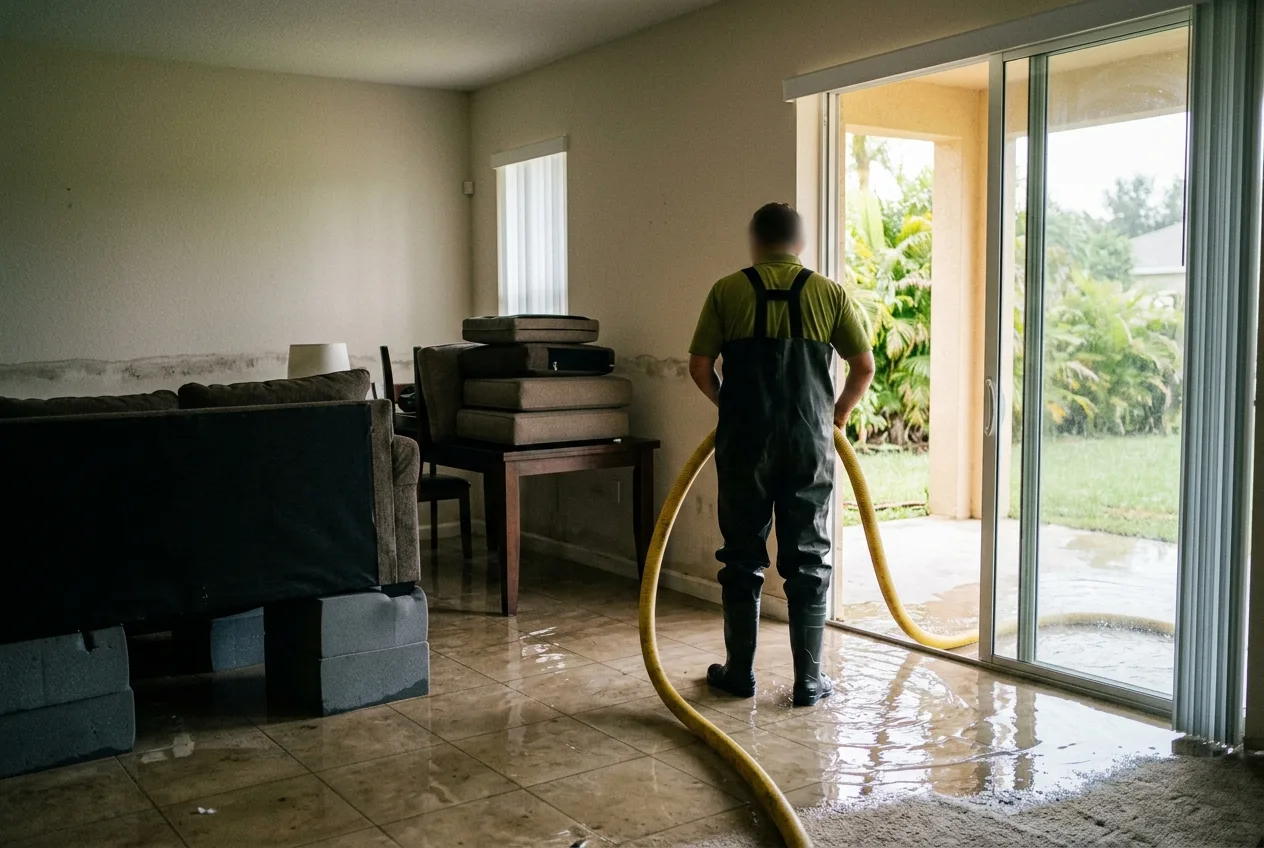
Flood Damage Restoration in Davie
Flood damage restoration in Davie and surrounding areas. Insurance billing accepted. Call (954) 932-5420.
Standing water doesn’t wait. Within the first hour after a flood, it migrates under baseboards, wicks into drywall, and begins saturating subfloor assemblies in ways that aren’t visible from the surface. Within 24 to 48 hours, that hidden moisture becomes the foundation for mold colonization. Flood damage restoration is a race against that clock, and the margin between a contained loss and a gut-renovation is almost always determined by what happens in the first few hours on-site.
What flood damage restoration actually involves
Flood cleanup is not pumping out water and running a few fans. A proper post-flood restoration response involves identifying the water category (clean supply-line water, gray water from appliances or overflows, or black water from sewage or storm surge), mapping the full extent of moisture migration with thermal imaging and pin-type meters, and then executing a drying plan calibrated to the materials affected, concrete slab, engineered hardwood, spray-foam cavity insulation, and plaster all dry at different rates and require different equipment configurations.
Commercial-grade truck-mount extractors remove bulk water far faster than portable units. Desiccant or refrigerant dehumidifiers then pull moisture vapor from the air and from building materials simultaneously. Air movers are positioned to create a directed airflow pattern across wet surfaces, not just placed randomly around a room. Moisture readings are logged at every visit so the drying curve can be documented and adjusted. For Category 2 or Category 3 losses (gray or black water), antimicrobial treatment and, in many cases, controlled demolition of non-salvageable materials is part of the scope from the start.
In South Florida, the baseline indoor humidity already hovers in the 70–80% range during summer months, which means equipment that might dry a room in three days in a drier climate can take five or six days here without the right dehumidifier capacity on-site.
Our process
-
Emergency water extraction and safety assessment. The first priority is removing standing water and identifying any electrical, structural, or contamination hazards. Category 3 losses, storm surge, sewage backup, or rising groundwater, require PPE staging and containment before crews enter affected areas.
-
Moisture mapping and scope documentation. Every affected surface is metered and photographed before demolition decisions are made. Thermal imaging identifies moisture behind walls and under flooring that would be missed by visual inspection alone. This documentation becomes the foundation of any insurance claim.
-
Controlled demolition of non-salvageable materials. Wet drywall below the flood line, saturated insulation, and swollen engineered flooring are removed to expose cavities for drying. Flood cuts are made at a height that allows structural members to dry while limiting the scope of reconstruction.
-
Structural drying with daily monitoring. Industrial dehumidifiers and air movers run continuously. Moisture readings are recorded at each daily check-in and compared against established drying targets for each material type. Drying is not declared complete until readings reach acceptable dry standards, not just when the equipment has run for a set number of days.
-
Antimicrobial treatment and clearance. Once materials reach dry standard, affected cavities and surfaces receive antimicrobial treatment. A final inspection confirms no residual moisture pockets remain before reconstruction begins.
What separates a good flood damage response from a bad one
The most common mistake in residential flood damage repair is declaring a structure dry before it actually is. Surfaces feel dry to the touch long before the moisture content of structural lumber, concrete block, or subfloor assemblies reaches acceptable levels. Crews who pull equipment early, often to move to the next job, leave behind hidden moisture that produces mold within days and voids any drying warranty.
A second common failure is misclassifying the water source. Storm surge in Davie and Broward County regularly carries groundwater contaminants, lawn chemicals, and in older neighborhoods, trace sewage. Treating a Category 3 loss as a clean-water extraction, skipping antimicrobial treatment and PPE protocols, creates liability for the contractor and a health hazard for the occupants.
Insurance adjusters look for a complete moisture log with daily readings, photographs of flood cuts before and after, and documentation of the water category determination. Gaps in that record are the most common reason supplemental claims get denied. A thorough documentation package from the start protects the homeowner’s claim, not just the contractor’s invoice.
What does flood damage restoration cost?
Typical costs for flood damage restoration vary significantly based on water category, affected square footage, and whether flooring and drywall require replacement. Most homeowners pay somewhere in the ranges below, these are industry-typical figures, not quotes from RestorationXpress.
| Scenario | Typical range |
|---|---|
| Single room, clean water (Category 1) | $1,200 – $3,500 |
| Single room, gray or black water (Category 2/3) | $3,000 – $7,500 |
| Multiple rooms, clean water with flooring removal | $4,500 – $12,000 |
| Whole-floor loss, Category 2/3 with demo | $10,000 – $30,000+ |
| Crawl space or under-slab moisture intrusion | $2,500 – $8,000 |
| Commercial or multi-unit property | $15,000 – $75,000+ |
Every loss is different, square footage, material types, and contamination level all shift the number. RestorationXpress provides a written scope of work before any work begins so there are no surprises. Standard homeowners insurance typically covers sudden and accidental water losses (burst pipes, appliance failures, roof intrusion) but excludes rising groundwater and storm surge unless a separate flood policy through the National Flood Insurance Program (NFIP) is in place, a distinction that matters significantly in Broward County.
Seasonal and regional considerations
Broward County’s flood season runs roughly June through October, aligned with Atlantic hurricane season and the peak of South Florida’s afternoon thunderstorm pattern. Davie sits inland but is crisscrossed by drainage canals managed by the South Florida Water Management District, when those systems are overwhelmed by sustained rainfall, residential flooding follows quickly and affects neighborhoods that don’t typically think of themselves as flood-prone.
The combination of high ambient humidity and warm year-round temperatures means mold can begin colonizing wet materials within the first day here, faster than the 48-to-72-hour window often cited for cooler climates. That accelerated timeline makes same-day extraction critical after any significant water intrusion.
Service area
RestorationXpress is based in Davie and provides flood damage restoration throughout Broward County, including Fort Lauderdale, Hollywood, Pembroke Pines, Miramar, Cooper City, Weston, Plantation, and Sunrise. The city-specific pages linked from this one cover local considerations for each area, housing stock, common flood sources, and typical insurance carrier relationships in that market.
If your property has standing water or you’re seeing the early signs of flood damage, soft flooring, damp baseboards, a musty smell that wasn’t there before the last rain, call RestorationXpress at (954) 932-5420 to schedule your moisture assessment and get a written scope before the damage has time to compound.
Frequently Asked Questions
Does homeowners insurance cover flood damage restoration?
How long does structural drying actually take after a flood in South Florida?
What's the difference between Category 1, 2, and 3 flood water, and why does it change the cleanup process?
What should I do — and not do — while waiting for the restoration crew to arrive?
How do I know if my floors need to come out, or if they can be dried in place?
Looking for the best flood damage restoration company in Davie?
RestorationXpress provides licensed and insured flood damage restoration in Davie, FL and the surrounding area, and has served local property owners since 2011. Customers rate us 4.9 out of 5 stars across 132 Google reviews. We answer calls 24/7 — call (954) 932-5420 for immediate help.
Need Flood Damage Restoration now?
We respond 24/7 across Davie and surrounding FL cities.
Related Coverage
- Our Restoration Services
- Contact RestorationXpress
- Flood Damage Restoration in Cooper City
- Flood Damage Restoration in Fort Lauderdale
- Flood Damage Restoration in Hollywood
- Flood Damage Restoration in Miramar
- Flood Damage Restoration in Pembroke Pines
- Flood Damage Restoration in Plantation
- Flood Damage Restoration in Sunrise
- Flood Damage Restoration in Weston