
Homeowners insurance sometimes covers water damage, but whether your specific claim gets paid depends almost entirely on the source of the water, not the amount of damage. The short answer: sudden, accidental water damage (a burst pipe, an appliance that fails overnight, a roof torn open by a storm) is typically covered. Gradual damage (a slow drip under the sink you ignored for six months, long-term humidity seeping through a foundation wall) is almost always excluded. Understanding that one distinction before you file, or before you call a plumber, can save you thousands.
The Coverage Dividing Line: Sudden vs. Gradual
Standard HO-3 homeowners policies cover “sudden and accidental” water damage. Insurers define that phrase narrowly and they look for evidence of how long the damage has been developing.
Covered scenarios typically include:
- A supply line to your washing machine bursts while you’re at work
- A pipe freezes and cracks during an unusual cold snap (yes, even in South Florida during a rare cold front)
- Your water heater fails and floods the utility room in a single event
- A neighbor’s unit above yours leaks into your ceiling (in a condo, though the liability chain gets complicated)
- Wind-driven rain enters through storm damage to your roof or windows
Not covered under a standard policy:
- A slow drip under a bathroom vanity that rotted the subfloor over months
- Seepage through foundation cracks or block walls, common in older Davie homes built before modern waterproofing standards
- Flooding from a storm surge, overflowing canal, or rising groundwater (that requires a separate NFIP flood insurance policy through FEMA or a private flood carrier)
- Mold that developed because a known leak wasn’t repaired promptly
- Sewer or drain backup, unless you purchased a specific backup rider
The practical test: if you could point to a single day the damage began, you’re in covered territory. If the damage crept in over weeks or years, expect a fight.
What to Do in the First Hour After You Discover Water Damage
How you respond in the first 60 minutes affects both the physical outcome and your insurance claim. Do these in order:
- Stop the source. Turn off the main water shutoff valve if a pipe or appliance is involved. In most Davie homes, the shutoff is near the water meter at the street or at the side of the house. If it’s an appliance, pull the supply valve behind or beneath it.
- Document everything before you touch it. Walk through and shoot video on your phone, wide shots of every affected room, close-ups of standing water, wet drywall, stained ceilings. This footage is your evidence. Insurers can and do deny claims when they can’t see the original extent of damage.
- Call your insurance company or agent. Report the loss the same day. Most policies have a prompt-reporting requirement. Waiting even 48 hours can give an adjuster grounds to question whether the damage worsened due to your inaction.
- Start moving air. Open windows if outdoor humidity allows (in summer in Broward County, outdoor air is often 80%+ humidity, in that case, keep windows closed and run your A/C). Move wet rugs, furniture, and soft goods out of standing water.
- Do not use a shop vac on sewage-contaminated water. If the water came from a toilet overflow, a backed-up drain, or a flooded yard, treat it as contaminated. Aerosolizing that water with a vacuum is a health hazard.
What NOT to Do (Mistakes That Hurt Claims)
Don’t throw anything away before the adjuster sees it. Wet carpet, damaged drywall, warped cabinetry, all of it is evidence. Stack it outside if you must, but photograph it first and keep it until your adjuster has inspected or explicitly released it.
Don’t make permanent repairs before the claim is opened. Emergency mitigation (extracting water, running fans, tarping a damaged roof) is expected and covered. Ripping out and replacing drywall before an adjuster documents the loss is not, and it can result in a reduced payout because the insurer can no longer verify the original damage.
Don’t sign over your insurance rights to an unknown contractor on day one. Assignment of Benefits (AOB) agreements are common in Florida, and some are legitimate, but signing one before you understand what you’re agreeing to can transfer control of your entire claim to a third party. Read anything before you sign.
Don’t assume the adjuster’s scope is final. Insurance adjusters work for the insurance company. Their initial estimate is a starting point. You have the right to get your own estimate, hire a public adjuster, or invoke the appraisal clause in your policy if you disagree.
When the Damage Is Bigger Than a Few Towels
If water has been sitting for more than a few hours, has soaked into walls or flooring, or came from a contaminated source, the cleanup is beyond DIY territory, not because it’s complicated, but because of what happens next.
Water moves through building materials faster than it looks. A wet baseboard means the wall cavity behind it is wet. A damp ceiling tile means the insulation above it is saturated. Within 24 to 48 hours in Florida’s heat and humidity, wet organic material, drywall paper, wood framing, insulation, can begin supporting mold growth. Once mold colonizes inside a wall cavity, the remediation cost is significantly higher than the original water damage mitigation would have been.
A professional water damage restoration crew brings equipment that changes the math: truck-mounted extractors that pull water out of carpet and pad in a single pass, industrial dehumidifiers that process hundreds of pints per day (a household dehumidifier processes 30–50 pints on a good day), and thermal imaging cameras that find moisture behind walls without tearing them open unnecessarily.
They also produce the drying logs and moisture readings that insurance adjusters require to close a claim. If you dry the space yourself and can’t document that it reached the target grain levels specified in the IICRC S500 standard, your insurer may dispute whether the space was properly dried, and hold you responsible for any secondary damage.
How the Insurance Claim Process Actually Works
Once you’ve reported the loss, here’s the general sequence:
- Claim opened / claim number assigned, usually same day or next business day
- Adjuster inspection, in Florida after a significant weather event, this can take days to weeks; for a standard pipe claim, often 2–5 business days
- Scope of loss documented, the adjuster (or a contractor using estimating software like Xactimate) itemizes every damaged material
- Estimate issued, the insurer sends a payment for the Actual Cash Value (ACV) of the loss, minus your deductible. If your policy includes Replacement Cost Value (RCV), you receive the depreciation holdback once repairs are completed and receipts submitted
- Repairs completed and documented, keep every invoice, photo, and receipt
- Recoverable depreciation released (if RCV policy), submit your final invoices and the insurer releases the held-back depreciation amount
The whole process for a straightforward pipe claim in a single room can take 3–6 weeks. A larger loss involving structural drying, mold testing, and reconstruction can run 3–6 months.
If You’re Dealing With Active Water Damage in Broward County
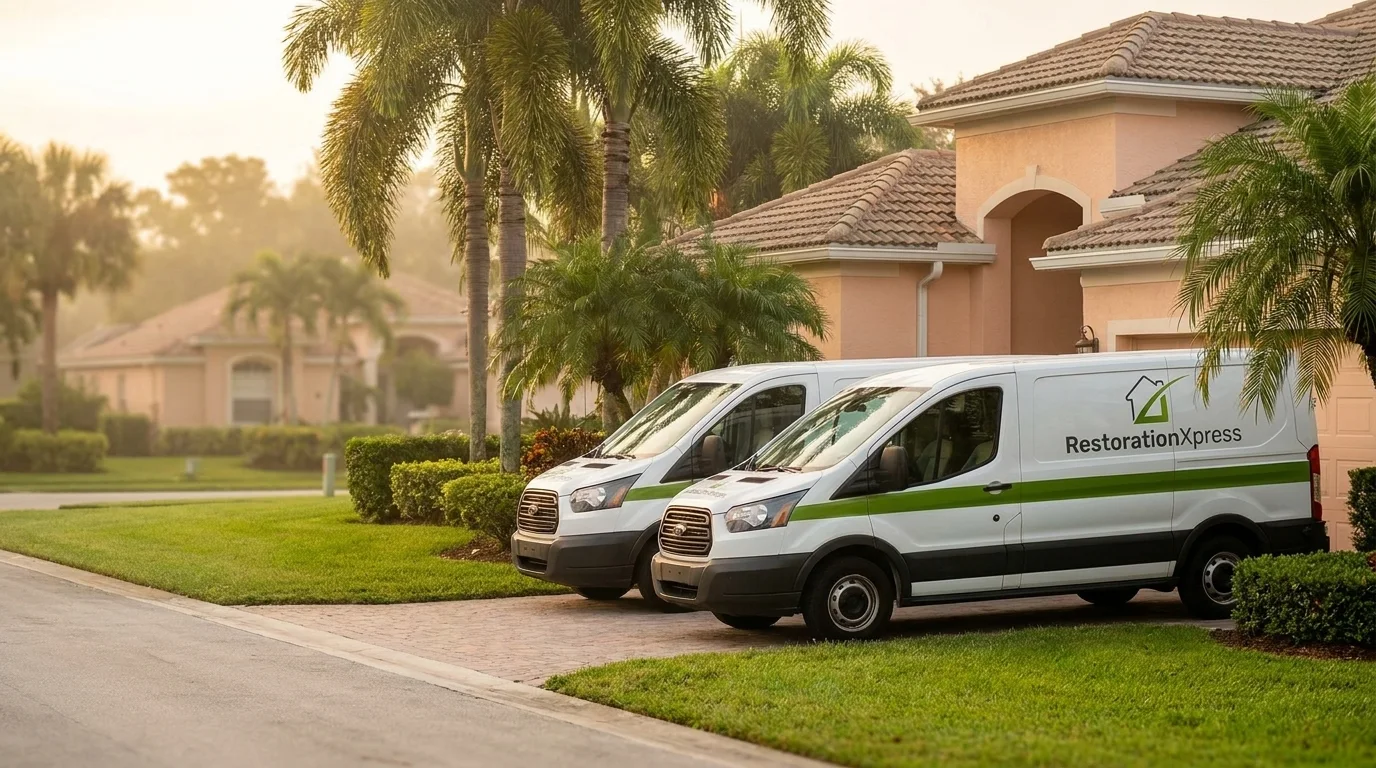
If you have standing water, soaked walls, or visible mold growth and you’re not sure what’s covered or where to start, the most useful first call is to a licensed restoration contractor who handles insurance billing directly, not because you’re obligated to hire anyone, but because they can tell you what they’re seeing, document it properly, and help you understand what your policy is likely to cover before you commit to anything. RestorationXpress serves Davie and the surrounding Broward County area and can be reached at (954) 932-5420.